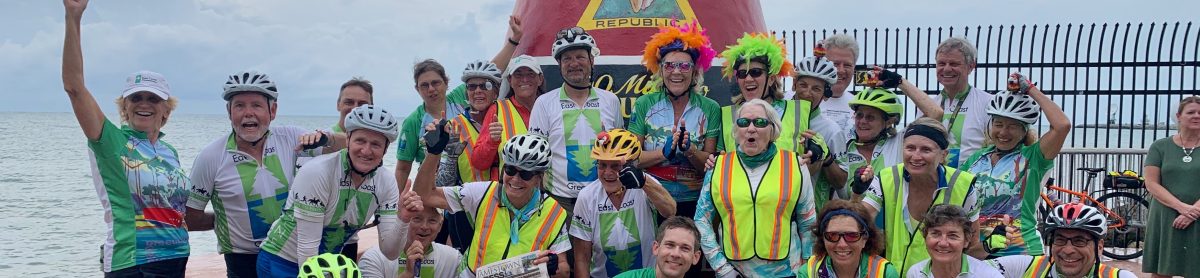
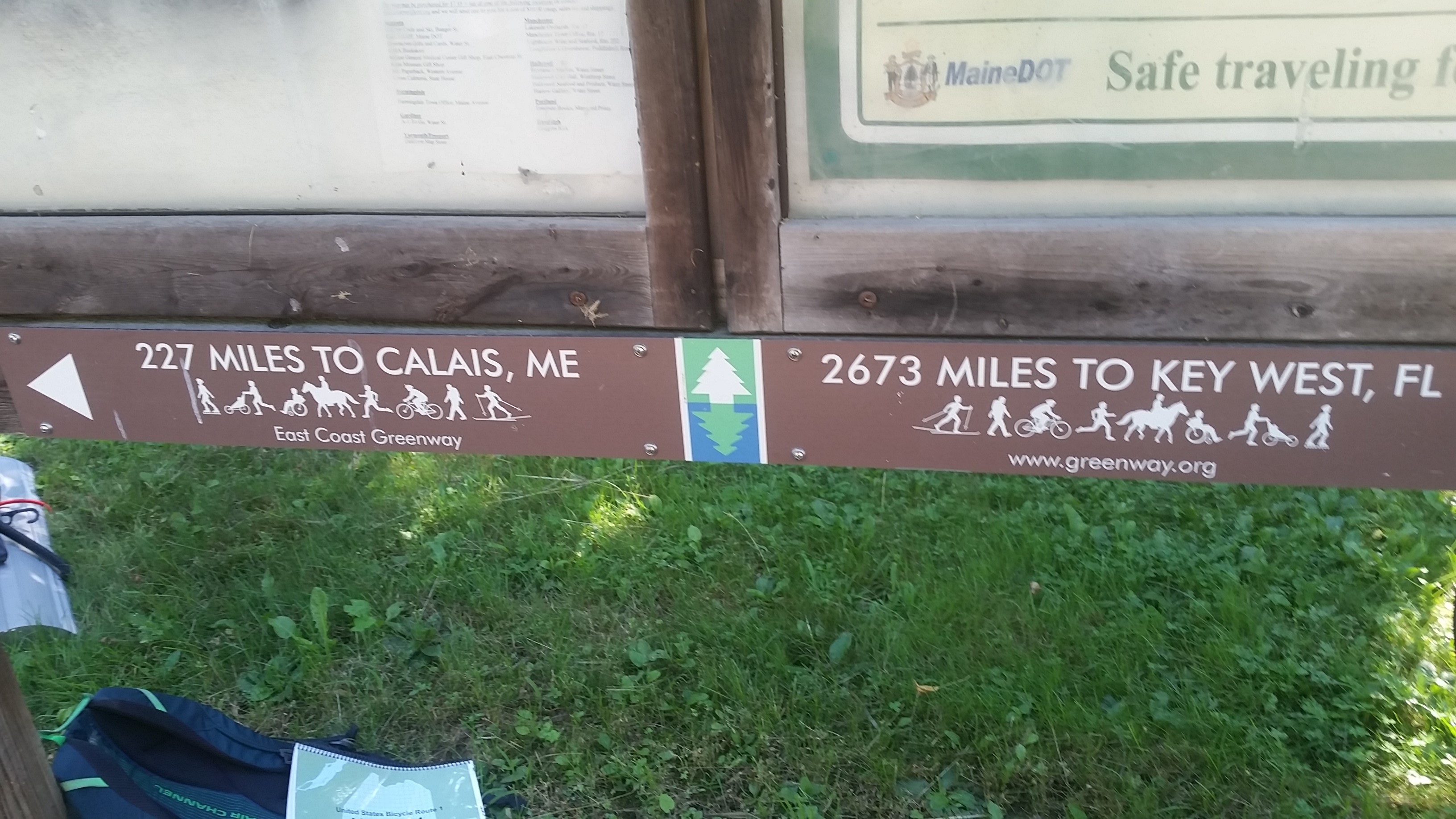
With this ride, these six closed their personal gap from Calais to Raleigh.
Bob Spiegelman says set this to the tune of “McNamara’s Band” (if, unlike me, you know it). We groaned at first — but it was a lovely end to our final group dinner.
Down East’s East Coast Greenway is the place we love to ride.
We bust our butts on up the hills and down the hills we glide.
We biked on trail, we biked on roads, we sometimes biked on sand.
Our week in Maine helped us see the Greenway’s great grand plan.
Our fearless leader Molly always kept her smile.
Andy did his best to keep us riding single file.
Alan and Walt supported us so we could ride carefree.
And Silvia’s blog kept track of things so we made history.
Barb and Bev together were an inspirational pair.
Russo bought an extra tire so now he has a spare.
Ash explained the local scene as we were near his home.
And Bob spent his time taking notes so he could write this poem.
Helen enjoyed her tour, without her bike buddies.
Aaron and Emily spent the week with a dozen old fogies.
Kate signed up and took the challenge with bravery and class.
We welcomed her to her first tour-it will not be her last.
Tina drove from Florida excited by the challenge.
But when she hit adversity she found a work around.
Donna was as steady as anyone could be.
Now she’s looking forward to October in Raleigh.
Chris showed everybody how to tear off lobster parts.
Don was chasing Pokemon while Clive missed playing darts.
The tour held close together, we had a lot of fun.
No other way to say it than “our group was number one.”
Down East’s East Coast Greenway is the place we love to ride.
We bust our butts on up the hills and down the hills we glide.
We biked on trail, we biked on roads, we sometimes biked on sand.
Our week in Maine helped us see the Greenway’s great grand plan.
I just want to thank everyone who supported the East Coast Greenway through this ride. (It’s not too late to show your support — click here for Silvia and here for Clive.) And thank you for reading about our adventures over the week.
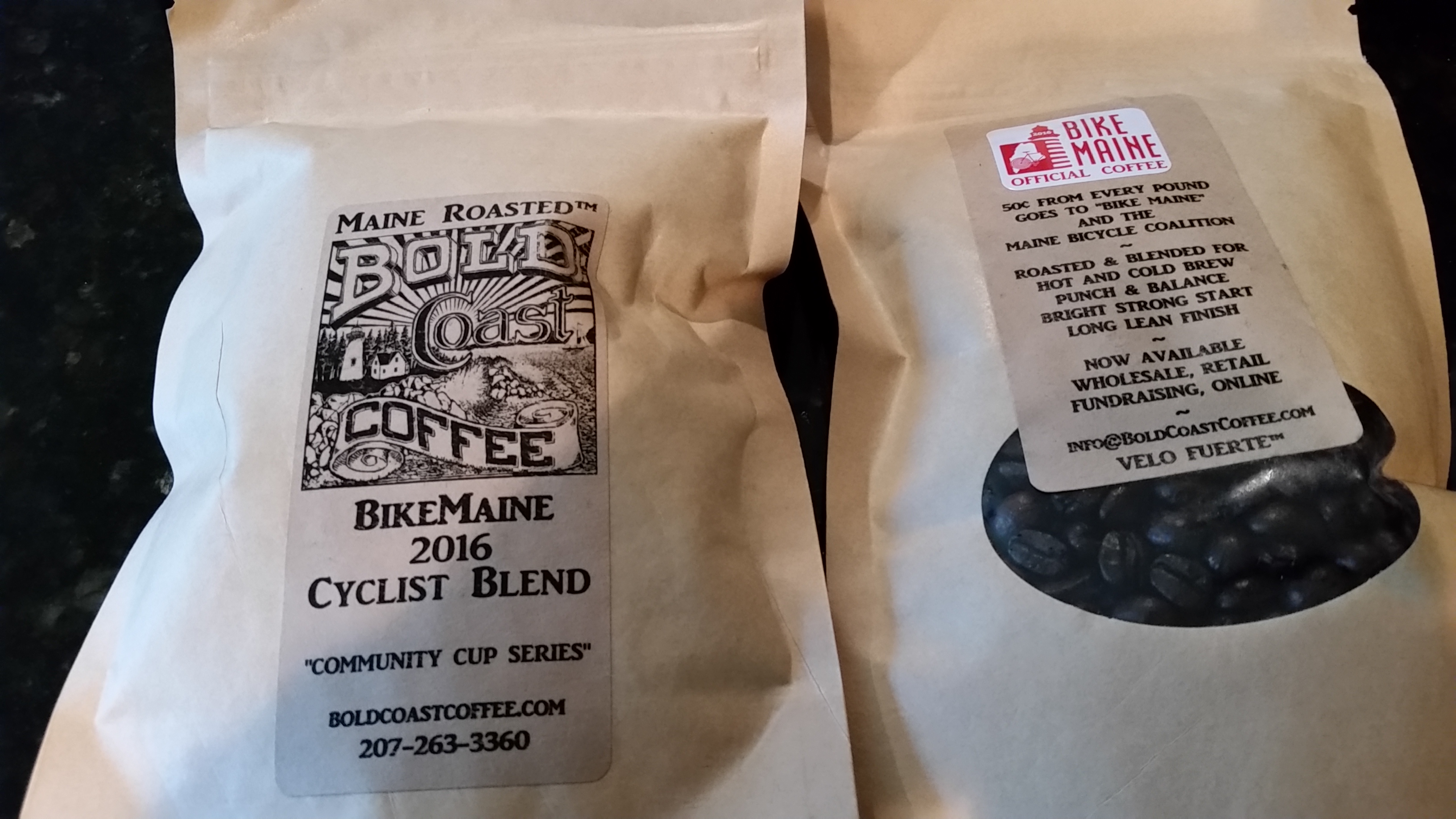
The Bike Maine ride happening next month has its own blend of coffee, and the photographer who took our photo in Machias for a local paper brought some for us (OK, he also works for Bold Coast Coffee):
Since I don’t drink coffee, I’ll have to rely on my fellow riders for reviews.
Ash, one of the two Maine residents on this trip, rode the entire route on a mountain bike — and took the road the first two days, rather than the Down East Sunrise Trail. Being a Down Easter, he’s already ridden a lot of that trail and figures he can do more whenever he wants. Hills were tougher than for those of us on road bikes, but he wasn’t the only one who walked a few of them.
He rode in regular shorts, no padding hidden underneath. Seven days and 350-plus miles? That can be painful.
We were in awe that he has built his own log cabin, beginning with felling the trees himself and turning them into logs. The cabin has solar power and well water but lacks every modern convenience — making it too rugged for Alan, our mechanic who dreams of being off the grid as long as he can still somehow run Netflix.
Ash has a deep interest in caring for the land — he built and maintains trails in his area. He’s ready to share it through a primitive campsite he has built on his property for cyclists.
When Clive spotted outdoor cookers near homes on Day 2, Ash explained they are outdoor wood-burning furnaces. People use them to heat water that runs through their homes and radiates heat. Of course I then had to start looking too. Clive spotted plenty of shed-like buildings with a smokestack that houses furnaces — and even a furnace for sale for $900 — but I never saw a one.
I’d include a link to his local newspaper’s article about him and this ride, but I can’t find it.
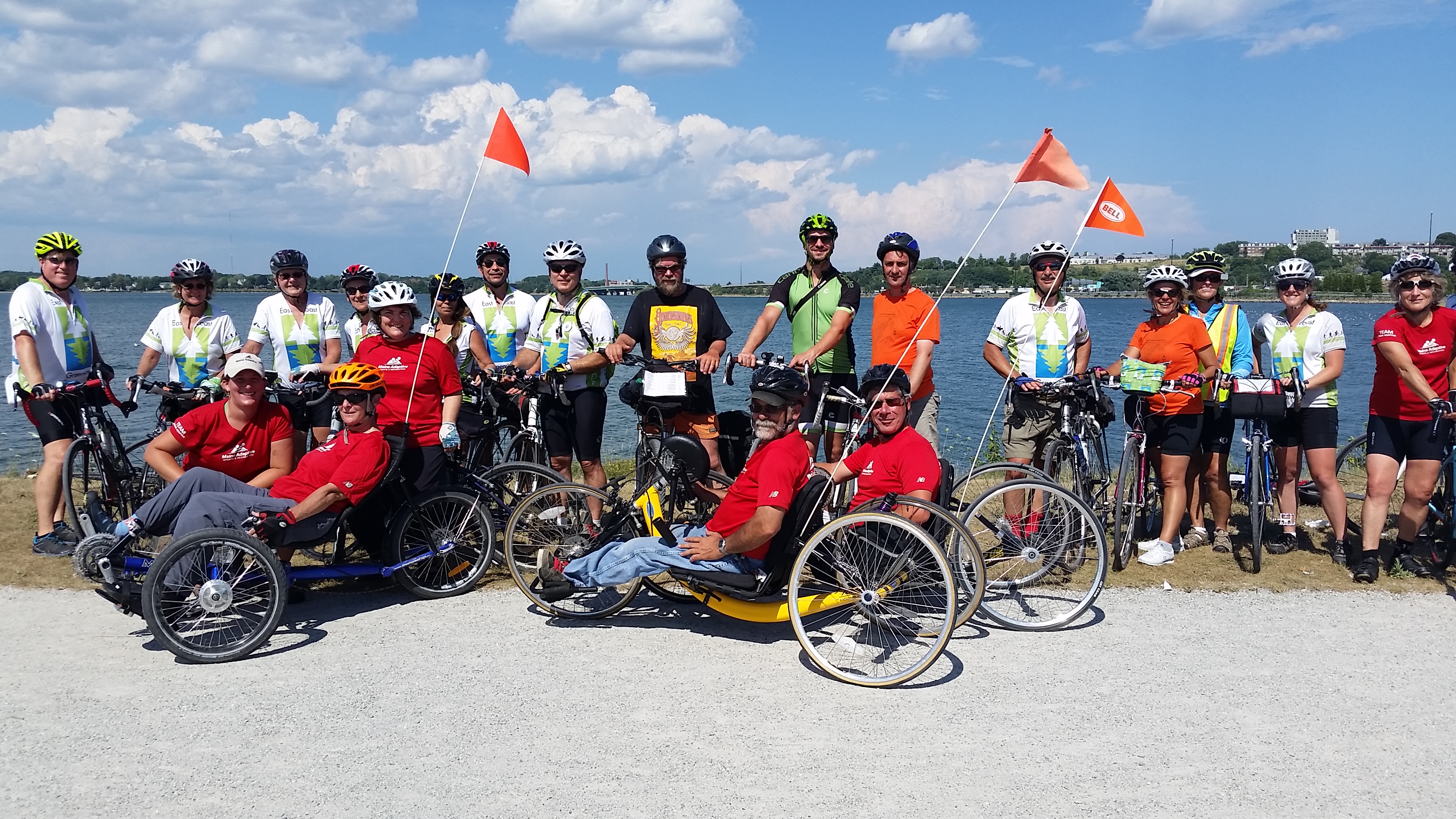
We capped off our week-long ride along the East Coast Greenway from the Canadian border in Calais to Portland with a victory lap around Portland’s Back Bay with an inspirational group from Maine Adaptive Sports. And we saw where a 10-mile trail could go between Lisbon and Brunswick.
We capped off our week-long ride along the East Coast Greenway from the Canadian border in Calais to Portland with a victory lap around Portland’s Back Bay with an inspirational group from Maine Adaptive Sports.
These are people in wheelchairs, perhaps since they were born, who bike, ski, kayak and golf with the help of volunteers. I chatted with one who started skiing in 1999 and added the other three sports in 2009. He regularly does three loops around the three-mile route, cranking with his arms instead of his legs, on a customized 20-plus speed bike that is built like an upside-down version of an able-bodied person’s bike (except for the seat, which isn’t upside down, of course!) and just flies down the descents. He’s now a mentor to others who join the program.
I hope this is the first of many ways the Week-A-Tour reaches out to groups beyond the local trail advocates.
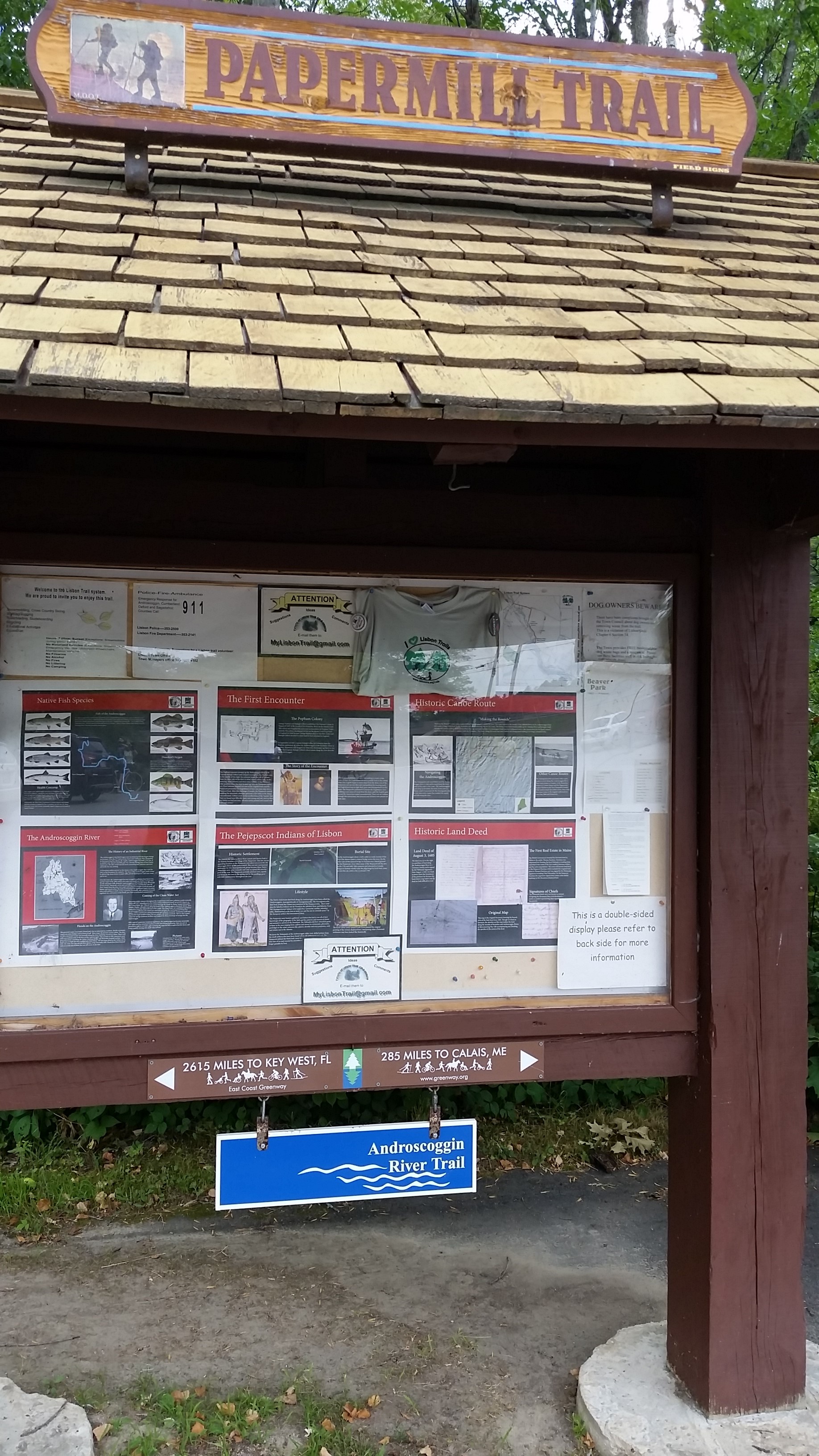
Another highlight of the final day was a beautiful three-mile trail in the Lisbon area, at least part of which is known as the Papermill Trail. It went by schools and dropped us off in a residential area at the edge of Lisbon. Once again, we rode through woods and along the river — what a wonderful way to bike to school!
When the trail ended, we found ourselves on the shoulder of a road with fast-moving traffic and of course climbing a few hills. And I could see a rail line in spots along the river (flat!), with weeds that aren’t kept in check by freight trains. It turns out that stretch of many miles from Lisbon to Brunswick on the other side of the river is abandoned — and owned by the Maine Department of Transportation. The state, however, doesn’t want to convert it to a rail-trail because it sees its mission as preserving it for future rail service. Fortunately, it is open to a rail with trail, and I will thrilled to hear of progress there. And yes, the old railroad bridge is still up.
As we left Bruswick (home of Bowdoin College), we stumbled across a very popular farmers market. It’s in a field just outside town, with lots of cars pulling in and out and parked along the road — not the most family-friendly bike ride to reach it. It really could use a multi-use trail alongside the road.
But there are bike racks, and they were pretty full (not just with a good number of our group!). We fell into conversation with a family of four at the nearby picnic table. The mother lamented how difficult it is to find a place to take the kids biking (the youngest son is about to start first grade). Seems kind of odd since Brunswick is a bronze-level Bicycle Friendly Community, according to the League of American Bicyclists, but that says a lot about how families define bike-friendly (and how well or not the word gets out about area trails).
I encouraged her to drive out to Lisbon for those trails (such a shame you have to say drive to bike) — but of course also had to fill her in with what I knew about the saga of that abandoned rail line.
From the moment we got on the Lisbon trail until we crossed the river into Brunswick was 13.5 miles. Imagine if it was all trail — so there was an alternative to those 10 miles of road. OK, it might be a little shorter and more direct, but you could organize a half-marathon from Lisbon (the schools?) to the Brunswick waterfront or Main Street. Double back and you’ve got a marathon. The training routes runners would have!
Imagine the bike rides locals would do, with a stop for a snack at one end. And how families could get out and ride without worrying about cars speeding by with nothing but a line of paint to separate the two. There’s an Amtrak station in town — think cyclists coming up from Portland or beyond. What an impact that could have!
One of the great things about the East Coast Greenway Week-A-Year ride is meeting passionate volunteers. Peter Garrett is one of those.
One of the great things about the East Coast Greenway Week-A-Year ride is meeting passionate volunteers. Peter Garrett is one of those. This soft-spoken Brit has lived in the Waterville area for nearly 40 years and has spent more than a decade building 40 miles of trails in Waterville, Winslow and surrounding towns for the astoundingly low cost of about $2.5 million (this article says $4 million, which is still cheap).
Peter has learned to be both patient and persistent. As he took a group of us along the Rotary Centennial Trail and the connecting East Kennebec Trail, he told us how his group, Kennebec Messalonskee Trails, asked the railroad if it could buy some land along the river that was no longer being used. It was told no .. and several years later, the railroad donated the land. Now I’m sure he left out a few details of how this gift came to be, but it is now a flat, grass-covered trail mowed by a volunteer we were introduced to.
If I’m remembering right, not only was the land donated but the company put up a fence at its own cost (rather than requiring the trails group to pay for it) to separate the trail and company land.
The surface on other parts of the trail was hard-packed soil or crushed stone, all at least as smooth (and sometimes more so) than the D&R Canal towpath near me that is a long section of the East Coast Greenway. Certainly none of that reddish-brown dust that caked my bike a month ago! And it was lovely to be in the shade (something we appreciated even more as we biked down U.S. 201 with none) and get a break from hills.
Peter is second from left
It got me thinking about what makes a good trail, and what makes a good trail segment for the East Coast Greenway. I don’t claim to be an expert, and I certainly don’t have the educational credentials. But that’s not going to stop me from offering my thoughts.
I thought: who is this for? As a cyclist, I think of the East Coast Greenway one way, but it’s also for runners, walkers and more. And even among cyclists, road warriors would look at it one way (they stick to the roads), touring cyclists another and recreational cyclists yet another. Do I personally prefer paved? Yes, because my road bike likes that better, though I then curse the bumps created by tree roots. Still, I took it on unpaved trails in Connecticut. I just can’t go as fast (and probably shouldn’t even on paved trails, the better to share with walkers and their dogs). But my hybrid can take anything. And give me these surfaces over the C&O Canal! I liked these trails.
If I was hiking a section of the East Coast Greenway, I would love this. There were scenic vistas and even a place to sit and eat. If I was running, ditto. And we saw a woman running alone, a sign that safety isn’t a concern. Is it wheelchair-accessible? Certainly the area where we exited isn’t — too steep, perhaps, and I would definitely pave it to avoid deep ruts from the rain flowing downhill. (We walked up — but that was no more than 10 yards.)
Can’t miss this! This is where we exited.
You can see only a tiny bit of the fence on the left. It’s an automated gate put in by the business next door (the railroad? remnants of the paper mill?) to keep trail users from parking on its property. Peter tells the story better, but it seems like more proof of how this community group works well with others.
I like that the trails connected to the schools. Does it mean it meanders a bit for a through-rider? Yes. But the added distance really isn’t much, and you could have jumped back onto the road for what I expect is less than half a mile if you wanted to skip that.
Peter’s trail is an “orphan” trail and not part of the main route. But given that tourism and the economic boost it provides are among the selling points for this national trail (and, of course, encouraging exercise as part of a healthy lifestyle), it seems to me that if it doesn’t become part of the main route, it should be listed as a loop or spur. The same goes for Donna’s Air Line South trail and the Lawrence Hopewell Trail near me. After all, the more there is to bike in one area, the more likely you are to linger or plan a weekend around it.
Peter’s group has great ambitions to connect to the Waterville side of the river using old bridge pilings. It’s a long way across, but given what this group has already accomplished, my money is on this one day happening.
The route that exists today led us to the Two-Cent Bridge, an unusual pedestrian suspension bridge that is more than 100 years old — and which Peter and co. got fixed up and re-opened. The name comes from the two-cent toll to cross the bridge.
Look at the fun sculpture (wearing my bike helmet) and bike rack on the Waterville side!
Not only did Peter show us his trails, but he played tour guide from Unity to his trails, entertaining us with little stories along the way.
If you like reading about passionate advocates, I’ve written about others here and here.
We rode on two trails today — the Kennebec River Trail and the Riverside Greenway in Lewiston.
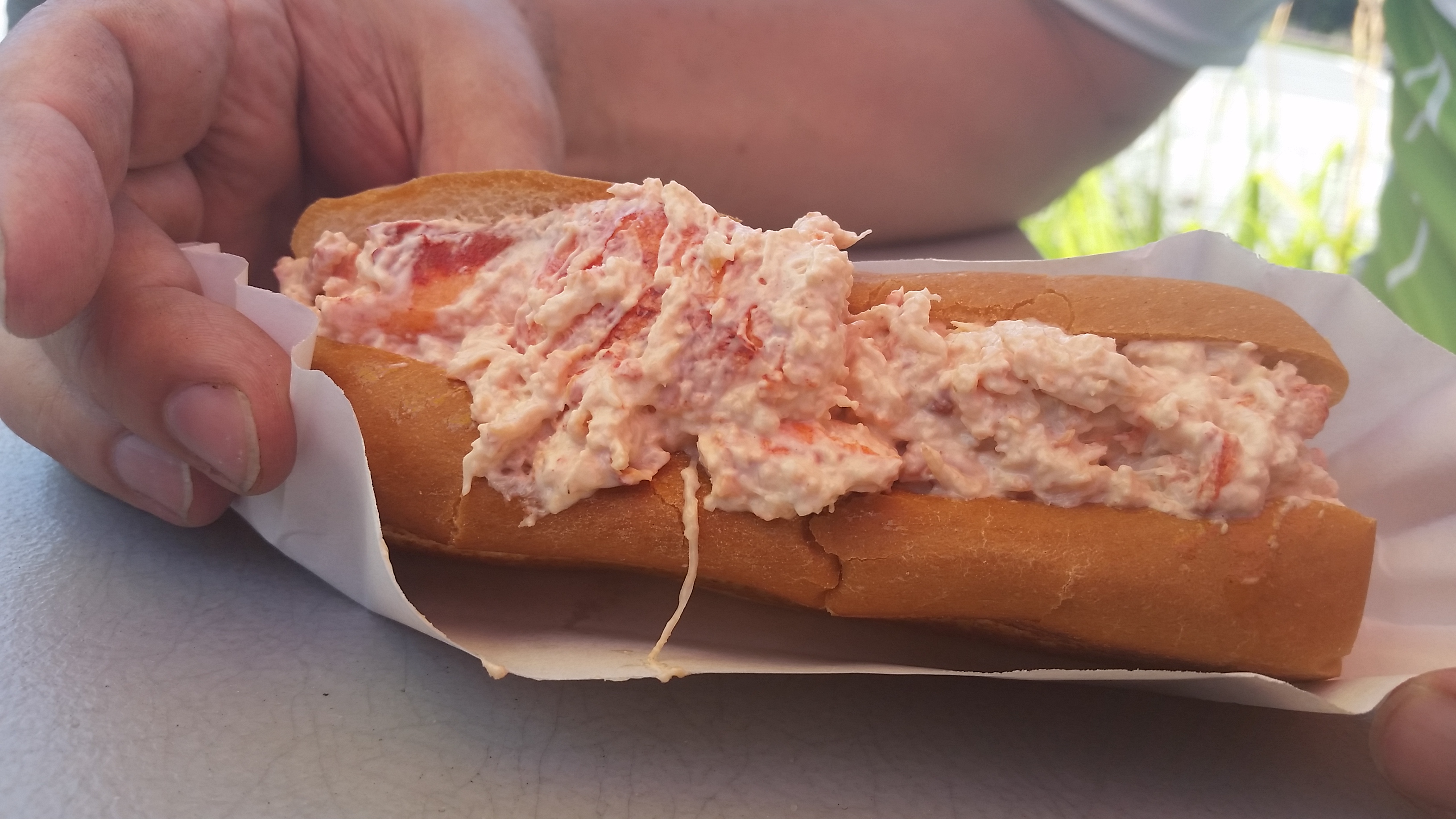
Today started and finished on wonderful trails. In between were mostly quiet roads, that evil 15% grade on part of a two-mile climb and a press event with the Maine Department of Transportation. Oh, and a lobster roll at a hole-in-the-wall. Properly toasted, unlike the one at the non-descript deli on Day 0 in Portland.
It was hot again, but we seemed to have more shade and the day didn’t end with a brutal climb. All told, we “officially” climbed 1,816 feet (but descended more — yay!). We pretty much behaved ourselves — no crazy detours today. And once again thanks to another wonderful SAG who kept us well-supplied with water.
The Kennebec River Trail in Augusta was lovely, with the river on our left and taking us blissfully traffic-free (and hill-free!) about 6 1/2 miles to Gardiner. It’s somewhat unusual in that it’s a rail with trail, rather than a trail on a former rail line. Notice there’s no fence between the rail and the trail.
This photo of two Kennebec Trail users comes from a fellow rider. The mother is 90 years old. Her daughter can’t walk. Just two reasons why we need more trail!
Here’s an impressive theater in Monmouth — too big to fit into my photo! With an impressive list of productions for the summer season. And the town has just 4,100 people.
At the end of our ride was the Riverside Greenway in Lewiston, with the Androscoggin River on our right, before we crossed over to Auburn and our hotel:
Food picture of the day is my $8 lobster roll, with nice chunks of lobster:
What else I’ve learned about food in Maine: For ice cream, Gifford’s trumps Hershey’s. Much better range of flavors. And not much cookie dough in the Hershey’s ice cream version.
One more day to go — hard to believe this bike adventure is almost over.
I found it at our hotel in Augusta — chunks of lobster, squares of roasted seaweed (nori), spicy chili aoli, topped with scallions and toasted sesame seeds. And of course oozing with cheese — asiago and mozzarella. I’d cut down on the cheese and let the lobster shine through.
Bonus: half-price pizzas during happy hour. And then they let me bring it to the restaurant.
Can I confess that I’d be back for the weekday lunch pizza buffet? I’d try the crabmeat pizza, the pear, walnut and gorgonzola one…
It once cost two cents to walk across this bridge.
I thought Maine weather was supposed to be on the cool side, and I packed accordingly.
Wrong move.
Today was particularly hot — I think it topped 90 — and that made it a tougher day, especially on the back half of the ride, all along U.S. 201 with barely a lick of shade.
Once again, the East Coast Greenway route overlapped with U.S. Bicycle Route 1. Climbing-wise, the “official” cue-sheet estimate was 2,032 feet, which seemed OK. But there was a really nasty hill in Augusta, after the heat had worn us down, and we had already detoured to the Viles Arboretum, which involved another big hill.
The day’s big highlight was being guided by Peter Garrett during the first half of the day, until we got to Waterville. Peter has led an amazing effort to build trails in the area — 40 miles and counting, for astounding low cost of about $2.5 million. He’ll be the subject of a separate post.
We stopped at the headquarters of Johnny’s Seeds, a fun spot for any gardener. Wouldn’t I like this sort of protective set-up in our garden!
Usually we spend the night in hotels. But tonight we’re in the dorms of Unity College, a private college of 665 students focused on sustainable (ie environmental) sciences.
It’s better than the cinderblock building I lived in during my first two years of college at Mizzou. Five of us are in a suite — three bedrooms (one is a single), one lounge (big kitchen sink, no appliances), one shower, one half-bath. More space than the youth hostel in Richmond on last year’s ride. No air conditioning. Got to keep the beer hidden.
On the other hand, we’ve got the fastest internet service in days!
Dorm food has gotten better too (yes, I’m back to food). There was grilled chicken and also a vegan option, plus pasta with a spicy tomato sauce, a few options for side dishes of veggies and a generous salad bar with mixed greens, not iceberg lettuce. And we could have seconds — possibly dangerous when you’re dealing with cyclists.
And there’s real ice cream, not just soft-serve:
Too bad the chocolate syrup container was empty. I tried not to be crushed:
Admittedly, some of the good stuff was off-limits to us:
But it’s disappointing to read a printed poster from a college where “it’s” is spelled “its”.
And — really, college kids? Clearly I am a different generation:













 Exploring by bicycle