I gave up trying to talk myself into driving in one day to Wilmington for the start of the East Coast Greenway’s annual weeklong ride, deciding to break it up with a stop in Richmond.
The appeal: the Virginia Capital Trail, 50 miles of off-road trail from Richmond (the state capital) to Jamestown, the first settlement. It was finished a few years ago and is a spur route of the East Coast Greenway.
I had time for an afternoon ride and debated where to start: Richmond or somewhere mid-trail? I only knew of Charles City, so that’s where I went. Turns out I was 20 miles from Jamestown … that would be 40 miles round trip. Could I do it?
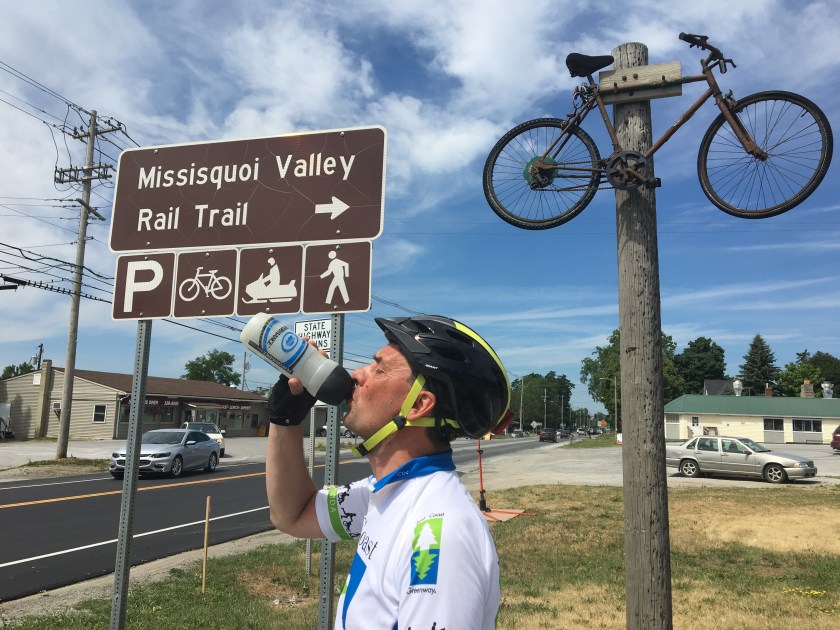
See the bike in the background of the sign? I figured the 2,000 miles referred to bike miles, hopefully in the form of trails and not just paint on the side of the road or, worse, sharrows. After all, it was right by a paved trail.
And I thought: Imagine if this really was what government wanted to do. New Jersey has 21 counties, so divided equally, it would be nearly 100 miles per county. Or do it by population, which would come at the expense of those really south and west, where they are too far to commute to the job hubs of NYC and Philadelphia. And if ideas for trails that were at least 5 miles long were prioritized, encouraging projects across municipalities and reducing the odds of random, disjointed trails not even connected by bike lanes … wow. (And the East Coast Greenway in New Jersey would be done! So would the Capital to Coast Trail, which may be coming back to life.)
But this is why I know this was all just talk around the time of the millennium: the governor on the sign is Christine Todd Whitman, who left office in early 2001. Usually every new governor gets his name on every sign possible as quickly as possible. Guess none of them wanted to own this one.
And the trail itself? We stopped at the Woodbine municipal center on the other side of the grassy median to ask where it goes. The receptionist had no idea. No clue about the name either. Turns out it’s the 3-mile Woodbine Railroad Trail following a section of the Pennsylvania and Reading Railroad. It connects the Cape May National Wildlife Refuge and Belleplain State Forest. Or at least peters out on what I hope are quiet roads. Downtown Woodbine looks like it has seen better days; the only commercial activity we saw was a Family Dollar store and a butcher’s shop/grocery. Would promoting the trail (and creating a small loop for casual riders) create a bit of economic pop?
I’m going to be blunt: This stretch of the East Coast Greenway is desperately in need of improvement — i.e. trails. I’m told that’s coming, but for now this is a one-star section.
This is a saner section.
Three of us rode from Trenton to Philadelphia on Sept. 15, 2017 as part of the East Coast Greenway’s River Relay that covers the entire 3,000-mile stretch: 25 years of East Coast Greenway, 50-plus rivers and one Greenway.
This was all urban riding– no trail, no suburban residential streets, nothing to give you a break from city biking and city traffic. To be honest, our “Portugal to India” ride, from Newark to Metro Park and then onward to New Brunswick was more pleasant and more interesting — and that’s not something most people associate with North Jersey, let alone Newark.
We started out from downtown Trenton aiming for the Calhoun Street Bridge. At one point, I thought we were headed for a busy highway, but the road forks in an odd spot and dropped us on the bridge. Chaotic Jersey road design and signposting, I thought…
At least the view of the Delaware River from the bridge was pretty:
On the Pennsylvania side, we picked up state Bike Route E (as in East Coast Greenway) … but don’t be fooled. This is hardly great bike infrastructure. Oh, it started out OK. West Trenton Road looks like a main suburban road, but it’s wide and there wasn’t much traffic. After several miles, though, we were on State Road 413. This is for hardy cyclists only; think wide, major road with strip malls, plus crossing an intersection with a road leading to Interstate 276 and of course traffic coming off the interstate too. Drivers saw us coming, so nothing scary happened. I know this is the reality of a route that connects cities rather than sticking to the middle of nowhere — there is always a bad stretch. The good news is that the route will look very different in four years when some projects are finished (pardon my cynicism when I bet it will be 6). Certainly the map showing the future ECG route looks much more appealing.
2019 UPDATE: The remaining obstacles on the D&L trail between Morrisville (opposite Trenton) and Bristol have been removed this year. It’s now a clear trail for 10 miles — and you stay off what we experienced above. Here’s a report of our 2018 experience.
I just kept wondering who’d get a flat from the junk on the shoulder.
So I was quite surprised when Bristol Pike — U.S. Highway 13 — turned out to be far nicer. For one, it was freshly paved. And there was a bike lane. It even felt fairly sane. I thought we’d be cruising.
But then one of us got a flat. Yes, of course it was the rear wheel. We pulled over on the sidewalk in front of a used car dealership to swap out the inner tube. The two men working there wandered over to see what was up. They nicely offered us water, use of the restrooms … but also gave us a different perspective on Philadelphia.
Business is slow, I heard, and it’s due to the bad economy — in this case, too many drugs. And these days, drugs means opioids and heroin. We apparently had just gone through a town with lots of (unregulated) halfway houses for addicts who had gone through substance-abuse treatment and were not far from a north Philadelphia neighborhood that he described as the epicenter of the opioid crisis. He never went into Philly without his gun, and he warned us to be careful. We thought he was a bit OTT and we certainly weren’t going to go find ourselves some guns.
Not that our route went through that part of town anyway. We stayed pretty close to the Delaware River but only once actually saw it. That was when we did our special Relay task and collected our sample of Delaware River water in Pleasant Hill Park. We found a bit of trail … but then it’s blocked by the Police Department not wanting anyone near its gun range (not that we heard any shots). Also OTT. This says safety upgrades would mean that section would open in the summer of 2017, but obviously that hasn’t happened. (We did make it through that blocked section in 2018, known as the Baxter Trail — it’s now open on weekends only in the summer.)
Collecting water samples from the Delaware River
Apparently there are a number of unconnected trail segments along the northern Delaware River, and I’d hoped we’d have been able to ride some of them. But nope. Gaps supposedly will be closed in the coming years. Certainly the people of north Philadelphia deserve more trails as well as access to the waterfront. And the East Coast Greenway would have a more direct and scenic route that also would serve riders of all abilities.
And so we stuck to city roads, biggish ones like Torresdale, Frankford and Aramingo, moving away from the waterfront and then back toward it, finally reaching hipster Northern Liberties. Then it was onto the bike lanes on Spring Garden to the Schuylkill River and the train home. Total mileage, including getting to and from our train station and then from the Trenton station to the start: 44 miles.
Did we miss something that would have made the ride more rewarding?
Thank you, East Coast Greenway and Bicycle Coalition of Philadelphia, for working to create new trails and upgrade the route. Thanks, too, for the bike lanes we found! And thank you Riverfront North for doggedly working to make the waterfront accessible to all from the Philadelphia county line to the Frankford Boat Launch, and the Delaware River Waterfront for picking up the trail work there headed south.
“Trenton Makes, the World Takes” — or at least it used to be that way
What’s is like if you stay on the New Jersey side down to Camden and then cross the Delaware using the Ben Franklin Bridge? Here’s how to do it.
Time to experience the Pennsylvania side of the Delaware River.
Well, only some of the time.
But the trail on the Pennsylvania side of Delaware River (it’s actually along the Delaware Canal, which runs parallel to the river) is quite different from the one on the New Jersey side, to say nothing of the Delaware & Raritan Canal towpath from Trenton through Princeton and to New Brunswick. Continue reading “Single-tracking along Pennsylvania’s Delaware Canal and the D&L Trail”
A historical and family-friendly bike ride from Rocky Hill to Griggstown, home of that “notorious Tory spy” John Honeyman. Or was he really a spy for George Washington.
Time for another history-themed bike ride in New Jersey.
We ate our way around the world on this 46-mile jaunt through northern New Jersey.
Northern New Jersey may be the last place you think of for a bike ride: densely populated urban areas with way too much traffic (and potholes) to make a cyclist happy.
This East Coast Greenway adventure showed us we had it all wrong. And it highlights just what a melting pot this state is.
We discover more of the Lawrence-Hopewell Trail on a 20-mile ride that includes a few miles on the East Coast Greenway.
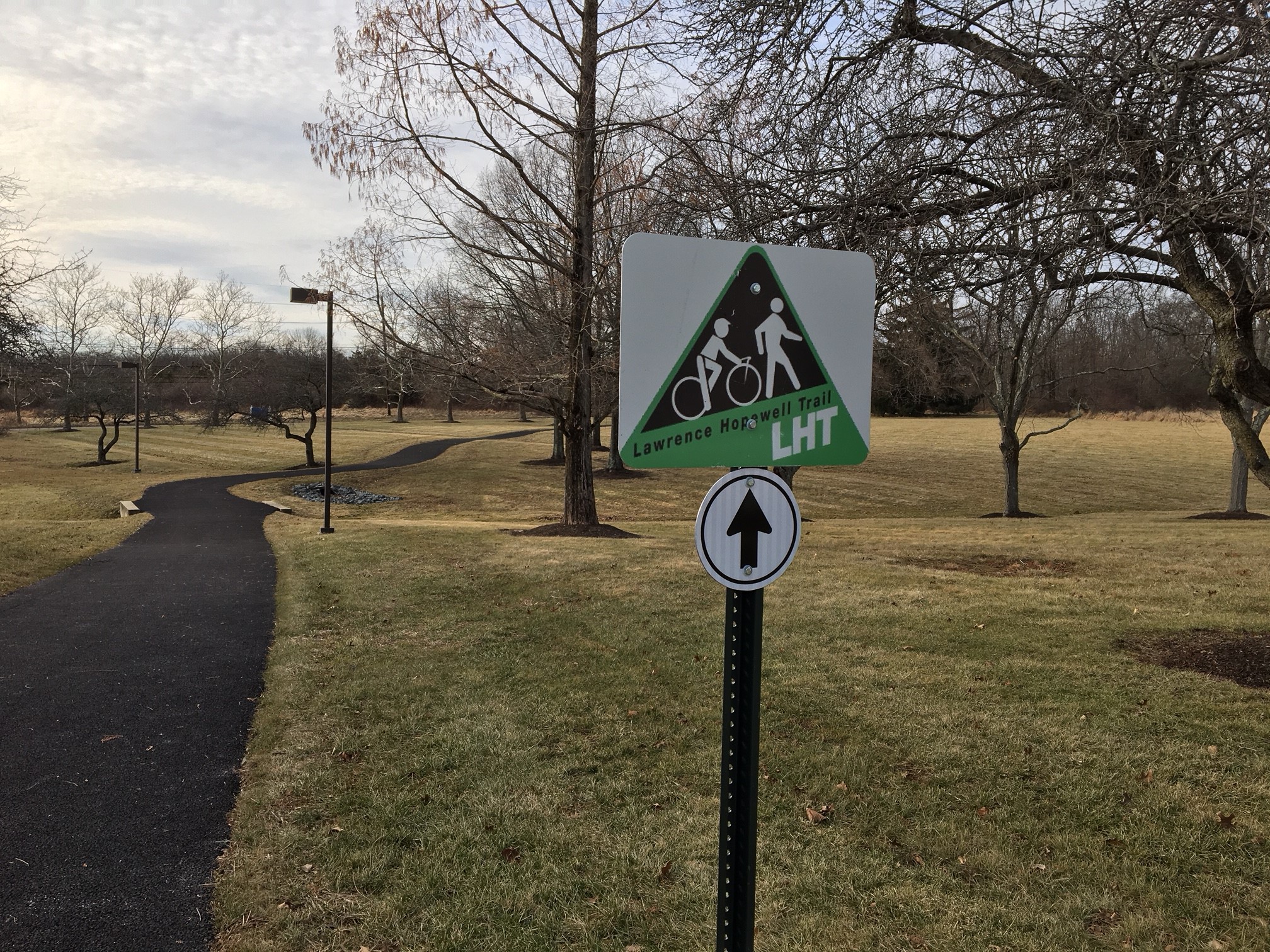
One of my longer bike rides over the past week was along part of the Lawrence-Hopewell Trail, a non-quite-finished 22-mile loop off the East Coast Greenway just south of Princeton.
We usually take the D&R Canal towpath (part of the East Coast Greenway) for about 5 miles to the turnoff to Brearley House and then ride past the Lawrenceville School and through Mercer Meadows, a big county park — basically going clockwise on the loop. This time we decided to go counterclockwise because we knew there was a section through the Carson Road Woods that we’d never been on.
Before we got to that, though, we found another section that’s been finished — a sidepath along Province Line Road. It’s the red dotted line in the upper right of this map, and its completion means the trail is 88% done. (See the full map here.)
I don’t have any photos, unfortunately, and it really seems like nothing glamorous — basically a wide asphalted sidewalk right at the side of the road, with no little strip of green acting as a divider. But it’s a key connection on a road that’s busy at rush hour and where motorists go fast at any time. One person I know grumbles about the drainage grates running across the sidepath every so often … and I could do without the rocks around them (probably also for drainage — UPDATE: driving by, that looks like it’s been covered). But it’s a big step.
After all that excitement, we rode the trail on the edge of a Bristol Myers-Squibb campus to reach Carson Road Woods. It has five miles of marked trails, including one mile that’s part of the LHT. Our route felt more meadow-y than the heavily wooded Maidenhead Meadows trail, another new section (for us, at least) near the start (the green dots leading to the parking sign on the map).
After Carson Roads Woods we rode through a neighborhood to Rosedale Road, where we’d seen an LHT sign but had no idea where the trail was. Now we know — neighborhood roads, then trail.
Had we continued on the LHT, we’d have gone through the ETS site, using a trail we’ve previously ridden. Instead, we turned toward Princeton and then home.
All in all, a 20-mile day. Essentially flat, but definitely one for the hybrids.
We hit part of the Eastern Trail in Maine and went off-route for hipster ice cream in Biddeford. (Hipster in the nicest way, of course.)
You might remember my not-so-patient wait for ice cream during last year’s week-long ride along the East Coast Greenway in Maine. Because of course you should eat ice cream while biking whenever possible.
We were back in Maine this month to visit friends. They said they’d be up for a bike ride …. so off we went on the Eastern Trail, another part of the East Coast Greenway. The section from Kennebunk to Biddeford is hard-packed, not asphalt, and in one spot a bit muddy after some rain. Glad we had the hybrids. It switched to quiet road through Biddeford and into Saco, where we stopped for lunch at a cute cafe with a deck. I, however, was more interested in ice cream. Not on the menu. Fortunately the waitress was a connoisseur and pointed us in the right direction.
So once everyone was fortified with real food (and my “side” of pulled pork had to be the equivalent of a breadless sandwich — somewhere between a quarter pound and half pound), off we headed to Biddeford and and the Sweetcream Dairy.
Our Maine friends and their ice cream
Oh, hipsters. This place is a registered dairy and milk processing plant. Can your favorite place in Brooklyn, Portland or wherever claim that? It batch-pasteurizes its milk. Locally sourced, of course. Provenance on the website. Maine herbs and fruits. I’d say it’s mostly farm-to-table for the ice cream crowd. And located in a repurposed mill — more hipster points.
“Mostly” locally sourced because how do you get local chocolate? Lemon and poppyseed? Key lime? In that true hipster way, it was well-curated — no 31 flavors and all that. Yet I was tempted by so many — rhubarb sorbet, perhaps?
A couple of samples later, I picked the dark chocolate. But there’s a twist: It was vegan. So not me. No idea what the secret non-dairy ingredient was, but it was awesome. I went for the kiddie size and it was so rich, I really could have used one of the citrus flavors to offset that. (Wonder if they’d do a half-and-half in a cup?) A single scoop would have been too much.
Sweetcream, get yourself a sign to and from the Eastern Trail!
All in all, nearly a 20-mile ride. One day I’ll ride the rest of the trail, from Portland down to the New Hampshire border. Stopping for ice cream, of course.
This is the coolest bike ride of the year so far — pedaling with George Washington (OK, a reenactor) and about 80 “troops” from the site of Battle of Trenton to the Battle of Princeton. All that was missing (beyond Alexander Hamilton) were some Redcoats in hot pursuit (even if that last part isn’t historically accurate). Next year!
This 10-mile “Chasing George” ride (with accompanying historical talks) was organized by the Historical Society of Princeton with help from a number of organizations, including a few of us representing the East Coast Greenway who escorted one company of “soldiers” from the Trenton train station to the Douglass House, site of a Council of War after the Second Battle of Trenton and the starting point for this ride. Some 37 of us took off behind General Washington, followed by 32 others who took a wider view of history. They had ridden out from just south of Princeton to Washington Crossing (site of the Dec. 25, 1776 crossing of the Delaware River) and then onto Trenton.
Yeah, the kids loved it. They made sure they were up front with George!
Our route wasn’t historically accurate; we took the D&R Canal towpath (part of the East Coast Greenway), which wasn’t built until the 1830s. The General and his troops had swung wide to give the Brits the slip that night. We ended up near the Princeton Battlefield as part of Princeton’s annual Ciclovia. Too bad it’s held on the edge of town, so attendance is pretty sparse.
But what was so important about these battles? These are the 10 days that saved the American Revolution. And it really was almost at an end. Washington had suffered one loss after another in the New York area and had essentially fled through New Jersey to just across the Delaware in Pennsylvania. Much of the Continental Army had signed up for one year and could go home at the end of the year. And on Christmas night, the army crossed the Delaware, despite the snow and the cold, and surprised the Hessians in Trenton on the morning of the 26th. They won, shocking the British. (And no, the Hessians weren’t drunk). Soldiers stayed on. There was a second Battle of Trenton on Jan. 2 and Washington’s forces held on as night fell. The British planned to finish them off in the morning, but Washington and his troops slipped out of town on a back road heading for Princeton and places north. British soldiers heading south to Trenton spotted them as dawn broke, and there you have the Battle of Princeton. Another win for Washington, and the Revolution was saved.
Want more? Read “1776” if you haven’t already. And catch the re-enactment of the crossing every Christmas Day, take part in Patriots Week in Trenton the week after Christmas and then watch for the Historical Society of Princeton’s own Battle of Princeton events just after that.
I love hearing about the economic impact of rail-trails because to me, that’s the most convincing argument for a trail. Usually the numbers come from some big study that makes some pretty broad-brush claims.
But here’s information from one bike shop in Hattiesburg, Mississippi, one end of the 43-mile Longleaf Trace.
Before the Longleaf Trace opened in 2000, Moore’s Bicycle Shop was one full-time person (the owner) and a part-timer. Sales in 2000 were $225,000 in a 1,400-square-foot store. A decade later, he had 6,500 square feet of retail space, five full-timers and one part-timer and average annual sales of $565,000.
Here are some money numbers from opening to 2014: more than $900,000 in additional payroll, more than $265,000 in additional sales-tax revenue (including $47,000 to the city) and an additional $96,000 in additional property taxes.
Plus he’s gotten more competition.
And yes, James Moore is a big proponent of the trail and hosted the first meetings to create it. He tells a story of the second meeting, when opponents got wind of it and came out in large numbers. One older man finally stood up and said he buys his car, his clothes and more in Hattiesburg and was happy that the Trace would give him a chance to spend more of his money in his community.
Now having ridden the length of the Trace, I didn’t see many places to spend money in the tiny towns along much of it. The businesses that are there may be doing a bit better (I did see one general store that sells bike lights) and could benefit from some signage telling out-of-towners about food and other services, but the bigger businesses are in Hattiesburg and in Prentiss, at the other end of the trail.
The Trace extended to downtown a few months ago, which should help businesses there. A Civil Rights museum is opening later this year to help tell the story of the Freedom Summer of 1964, when out-of-staters came down to register African-Americans to vote after the Civil Rights Act passed. Hattiesburg was the epicenter for southern Mississippi. The town is also working at connecting schools and the zoo to the Trace. Several miles out of town, there are big plans to develop an area around a pond into a fun place to while away the day,
More could be done: I hope they find a back-roads route so out-of-towners can get from hotels by the interstate to the Trace without having to drive. The Trace’s own website could come into the 21st century, and it would be wonderful to see more about the history of the area, from Indians to longleaf pine to cotton to whatever has come next, along the Trace.
Finally, a random fun fact about Hattiesburg: The zoo is home to two sloths and there’s a four-month wait to get 30 minutes of cuddle time with one. Cost is $40.