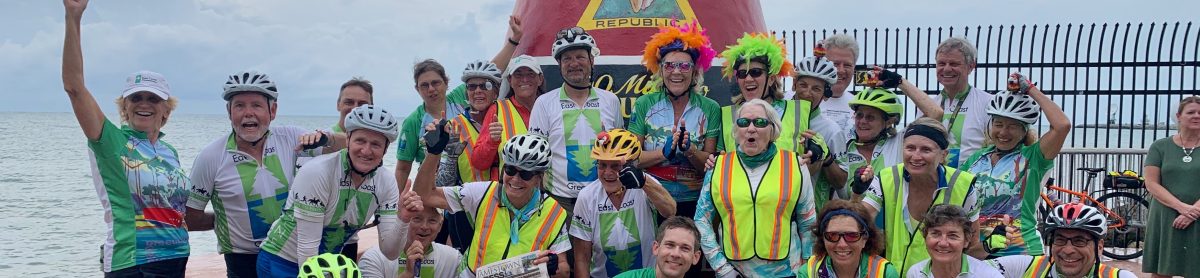

I love our bicycle adventures in Europe. All DIY, all different.
And we’ve learned from each one.
I want to share some of those lessons. Some come from our latest trip that included the D-Day beaches in Normandy, the Seine a Velo route and the Avenue Verte route from Paris to London. Others are from earlier trips along the Loire and in the Italian Dolomites down to Verona.
1. May through mid-June is a great time to be in Europe. Yes, I am saying this knowing that we missed the heat waves. But I loved how late it stayed light. Nearly 10 pm! That gave us flexibility if it did get crazy hot or it rained. We were in the Loire Valley in late September last year, which also was lovely. In both cases, our destinations weren’t crazy with tourists (Monet’s gardens at Giverny were an exception.)
But the sun goes down much earlier in the fall. And I’m glad I wasn’t on a bike in northern Europe in the second half of October a few years back — that trip had too much cold and and rain.
2.Taking our bikes from the U.S. was surprisingly easy. YouTube videos show you the basics. We then practiced packing them using much of that bubble wrap that I’ve saved over the years knowing it would be good for something; we reassured ourselves by paying a bike mechanic friend to supervise a test. We bought replacement derailleur hangers just in case. Pedals have to come off, so we bought a lightweight pedal wrench.
The handlebars had to be loosened and hung down and zip-tied the side of the frame. A tip from our mechanic friend: Use a metallic silver Sharpie to draw a line on your handlebars to get everything lined up right again.
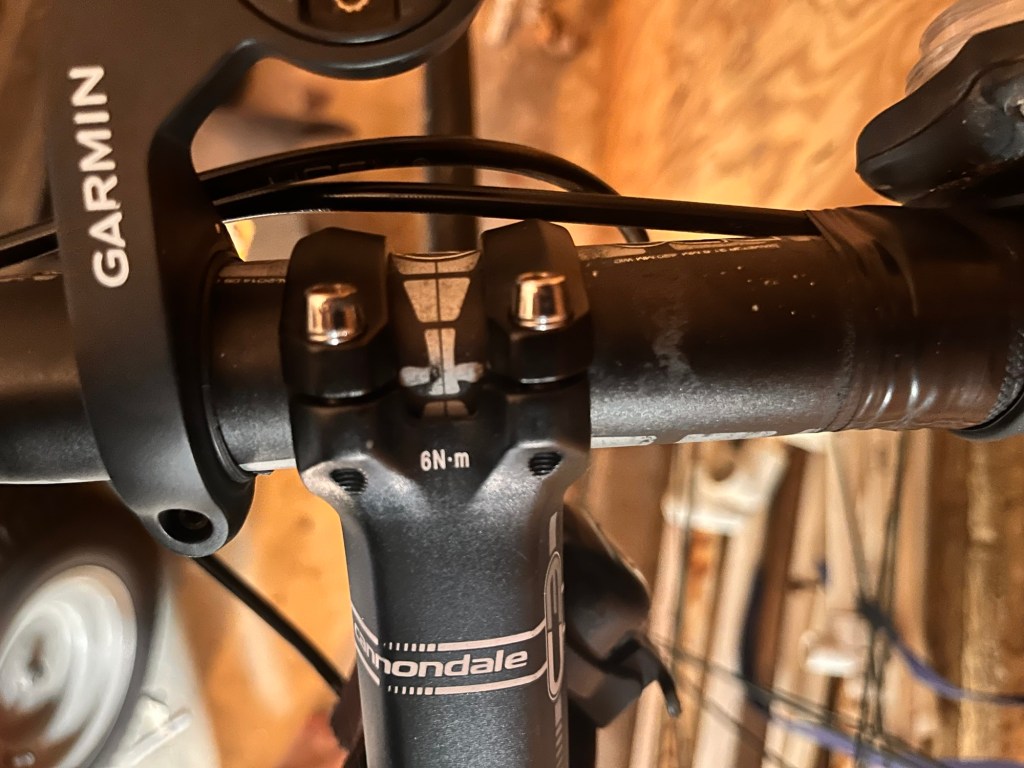
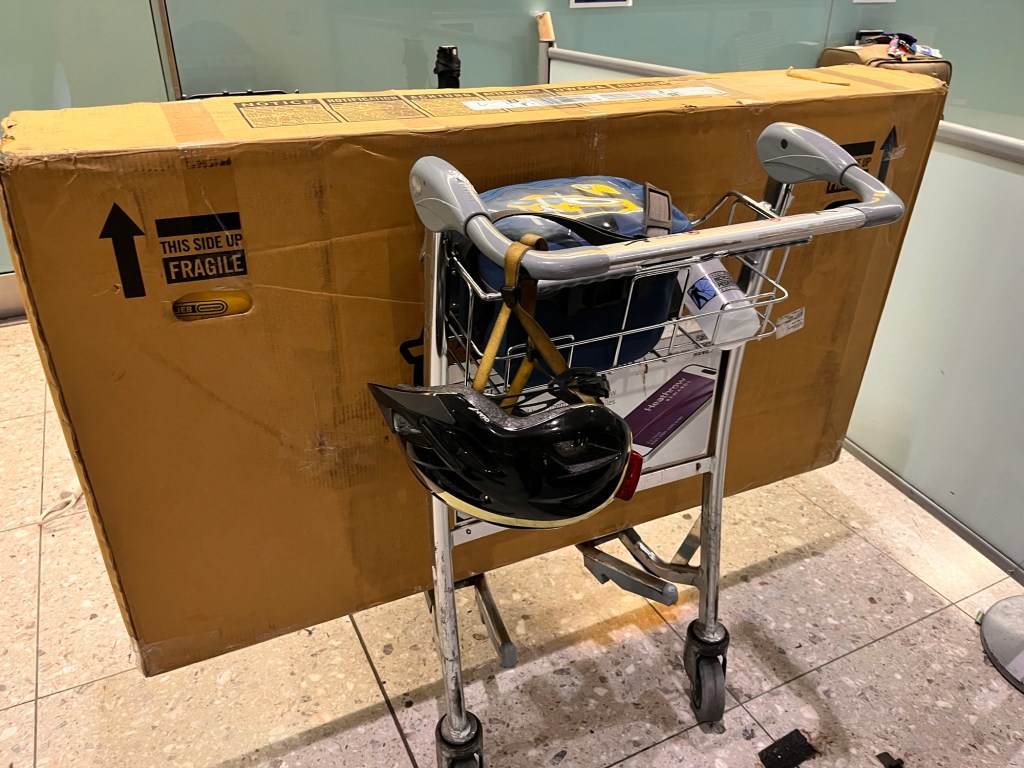
One bike travelled in a cardboard bike box, the other in a soft-shelled bike case with wheels. United treated each as our first piece of luggage (50-pound limit and no extra charge on top of that because it’s a bike). You do have to click the oversized luggage/bike option when checking in your bag, which we didn’t know. But a nice person at Newark Airport helped us fix that. And then the man at oversized baggage stepped out from behind the counter and just took the boxes. Honestly, I’m not even sure they were even weighed.
Both bikes came out fine on the other end.
Putting them back together was easy, though we had the luxury of doing it in a house rather than at the airport. (Thanks for picking us up, Tim!)

The bikepacking bag that attaches to my seat post was stuffed with clothes and became my carry-on luggage. The handlebar bag went in the case. My “handbag” was a light, reusable grocery bag that held my passport and other essentials. On the road we used it for … groceries.
3.Slow down! If I’m honest, too many of our 60-mile days on the Avenue Verte seemed to be all about the bike. I know, sometimes you have no choice; it’s set by where you can find a place to sleep.
Still, I should take more time for sightseeing along the way (pre-plan those breaks?) and/or work harder at shortening the mileage. Cut 10 miles or 20 km? Looking back, the long day biking through the vineyards in Alsace should have started in Selestat instead of Colmar so that it could have included a nice lunch (or at least another pastry) plus a wine-tasting later on. Or a stop at the bike cafe on the outskirts of Strasbourg. I’m learning I don’t need to get in right before dinner.
4.Along those lines, I need to go back to doing more research on the sights ahead of time instead of just winging it. At least I can ask AI. (Actually, let me do that right now for an upcoming bike trip.) Rouen was a wonderful surprise. What did we miss elsewhere?
5.Equally, I need to think more realistically about geography. I really wanted to go back to Strasbourg, and I got to see friends that way. But it involved a lot of extra train travel, and if you can’t get the bike spots on the TGV, you lose a lot of time. Perhaps we should have focused on Normandy and Brittany and saved Strasbourg for another time?
6.Finding a bike-friendly route is actually the easier part of trip planning. Europe has so many bike routes, starting with Eurovelo and going down to regional loops. In France, I would walk into a small tourist information office and leave with several maps. You can find many French routes using this website.
Use the train if you can’t find a nice route out of a city (Caen back to Bayeux!) or run into bad weather. We’ve found that regional trains are bike-friendly, though they may run out of space in the height of the summer. Rules vary by region and season, so at least read up on them before you leave home. For French TERs, see the map on this page and then click on the region you are interested in.
7.Bring laundry sheets from the dollar store. I found 15 for $1.50. Light, take almost no room in your pannier and get the job done. These might be old news to you, but I use liquid detergent at home. Sure, I can pack super light, think layers and even wash in a sink, but at some point I need a washing machine. And not every apartment rental will include detergent.
So while I like going from A to B (Avenue Verte, Seine a Velo), I also like spending a few nights in one place (Bayeux for the D-Day beaches and, last fall, Tours in the Loire Valley). Especially if it includes a washing machine.
8.You won’t need much cash. Use an online bank like Wise or Revolut that offer accounts in multiple currencies. Link it to your home bank account before you leave so you can replenish on the go. Use the virtual debit card to tap and go. Fees are minimal (I use Wise and spent less than $3 to get 500 euros instantly from my U.S. bank; it’s $10.53 for 2,000 euros), and the exchange rate is superb (essentially what the banks give each other for big amounts, not what banks give us for little amounts). This referral link saves you that fee for the first $600 transfer — a no-risk test.
Not only have I used Wise to pay for something on the spot, but I have used it to reserve a hotel room or apartment. You can see the card number on the virtual card. I’ve even used Wise to transfer euros to someone in Italy; much easier, cheaper and faster than a wire transfer from your bank.
I have read that Wise will let me withdraw $250 (or 250 euros?) a month for free at an ATM, but I have not yet done that. Will the other bank charge a fee for using its ATM, even if I am using a euro debit card? Would I pay that anyway if I was using my U.S. bank’s ATM card — on top of any fees my bank might charge and then get that worse exchange rate?
9.How did we navigate? Our Garmins only have U.S. maps on them. We use both Ride With GPS and Komoot at home. So here’s what we’ve settled on:
We take an old phone and download the routes (in our case from Komoot) using Wifi. Make sure to download/save it to offline! Both Komoot and Ride With GPS have that as an option. The same goes for the local map, at least with Komoot.
Then we attach the old phone to the bike on the handlebars, hook it up to a battery pack (stored in a bag on the top tube) to keep it fully charged all day, and follow the route using no data.
Note that Komoot does charge (we got a great lifetime deal in its early days). Ride With GPS also tries to get you to pay.
Looking ahead
I’m not saying we have it all figured out. There are things I am still thinking about.
1.On our latest trip, we booked all our overnights, ferries and TGVs before we left home, though we did have cancellable bookings where possible. It all worked. No stress.
But we are only two people. Should I still book all the accommodations early, or should I be more flexible, especially since we don’t travel in peak tourist season? We did book a couple of places on the fly at the tail end of our ride from the Dolomites to Verona several years ago. What’s the right balance?
2.Then there is cellphone data. Right now I have a T-Mobile plan that includes lots of free data overseas. But what happens if we run out? Yes, we use Wifi as much as possible and download our routes in advance. Should I look into an e-SIM from a European carrier? How do people handle two-factor authentication? Or, realistically, can that wait until I once again have Wifi?
3.Are there other apps and websites we should use? Can anyone share their experience with the cycle.travel app?
What’s the biggest lesson you have learned about traveling by bike?
Inspired by readers, I wrote about 8 more lessons!


We’re heading on a tour in September, a loop starting in Salzburg, and riding to Slovenia and back through northern Italy. We’re cutting our mileage down to 35-50 miles for more stops and sightseeing. Also not booking any hotels in advance from home. We will probably book a day or two before arriving.
We use ATT and they charge $12/day for unlimited talk, text & data, with a maximum of 10 days daily fees per billing cycle. Still pricey but gives us flexibility and peace of mind. I have used a local SIM card in past. Definitely cheaper but a hassle since you’re given a new local cell number.
LikeLike
Am grateful for the T-Mobile plan we have. We pay for calls but WhatsApp just uses data so is free.
LikeLike
Great blog! And thank you for the tip on laundry sheets – I’ve made a note for my next trip. I also like what you say about slowing down. Most of my tours are end-to-ends of European countries, which take a while, so there’s a balance to be struck between the cost and benefit of taking longer, but I do find my daily mileage is gradually going down, and not just because I’m older each year. It’s good to have the ability to be flexible and linger longer in places that are lovely surprises (though like you, I do need to spend longer researching the route in order to reduce these surprises and build in enough time to enjoy the sights I know I’m going to encounter along the way). On booking ahead v going with the flow: like you, I prefer the certainty of pre-booked (ideally cancellable) accommodation.
LikeLike
Thanks for all you said — glad I am not the only one wrestling with this!
LikeLiked by 1 person
Thanks for the Wise tip. I used an e-sim card I activated upon arrival, Nomad was the company. 10 gigabytes for a month. I used What’s App for texts and calls. This worked very well in Southern Italy this June. Last year, spring in Belgium I used booking.com for my daily hotel booking. Sometimes I would ride up and get a better rate. Sometimes booking,com had a better rate. I have a Charles Schwab account for ATMs. Supposedly they pick up the fee. That was hard to decipher in the paperwork.
LikeLike
Agree with all your points. We rode for 3 weeks in May this year along the Via Rhona and Canal du Midi and used gpx files from Komoot and from cycle.travel (downloaded Google maps of the region for off-line use) We loved cycle.travel. Definitely a good idea to have two digital files for the areas that are confusing. Also used the train briefly such as when traveling out of Lyon. Be aware that you may only have one minute to get off the train before it pulls out of the smaller stations. So have your bike and panniers by the exit door and ready to jump off. If you are in one of the last cars you may find yourself on the gravel before the train platform even starts.
LikeLike
great post.
ATM is really complicated as you are actually in a foreign country. A lot depends on bank 2 bank contracts if/ how much they will charge you at which ATM.
you need to check with your bank before leaving home.
for EU citizens, online banks that do not run their own outlets/ ATMs, they often offer withdrawals w/o any fees although you use other banks’ network. But opening an account just for your stay is probably top much effort, if even possible. Not sure. Maybe prepaid credit-card may do the trick?
Back then, when citibank was in Germany, I remember that cash from ATM in the US was free of charge for me. Alas…
LikeLike
This is why I really like Wise. At least I am not paying constant transaction fees and getting a lousy exchange rate. So much in Europe is now cashless, so tap and go works really well
LikeLike