
The Columbia Trail gets lots of love. It’s a 15-mile trail in Hunterdon and Morris counties that started life as a railroad, then became a trail when a gas company ran a gas line underneath.
A few words about the trail. You’re definitely going uphill for the first few miles out of High Bridge (where we parked), but nothing really steep because of that train history. It’s unpaved (thumbs up for the Hunterdon surface; the Morris section is more uneven). lots of shade. Watch out for horse manure on the Morris County side.
Along the trail:


But what really stands out for me is that Voorhees State Park (and camping) is just 2 miles away — and that it includes an observatory run by the New Jersey Astronomical Association. The observatory is open to the public on Saturday nights and Sunday afternoons from June through October (plus the fourth Saturday night in March, April and May).
Bike and stargaze — what an unusual combination!
So after a late-afternoon ride on the trail, we headed to the park. Let’s just say I’m glad we drove. We hit a 12% grade, and the Honda Fit was straining. I admit it doesn’t have a particularly powerful engine, but that’s still steep. On my bike, I’d have been straining more. And the road doesn’t have a consistent shoulder so walking your bike doesn’t seem like a great alternative.
Unfortunately we picked a cloudy Saturday for our road trip. No stars to be seen. But wow what a fascinating story behind the the building of the observatory and especially the 26-inch telescope, which is the largest publicly accessible one in New Jersey and one of the largest on the East Coast.
It starts with a small group of local men interested in astronomy. It’s the early days of the space race — is that what made them curious? One’s a jeweler, another an appliance repairman, another was in the perfume business, then a couple of school teachers and others … really, quite the cross-section of society.
Their first idea is for each to build a 10-inch telescope. But they soon realize that they’d be better off pooling their resources and building one big one that they can share with the public.
And here’s where the story gets wild.
It’s 1965. They hear that Indiana University has a 24-inch telescope that was used for astrophotography but fell into disuse in 1944, when they guy running it retired. They arrange to buy essentially the frame for $90, or almost $900 in today’s money. And they head to Bloomington, load this black metal cylindrical cannon-shaped contraption into a U-Haul and drive it more than 700 miles back to Clinton, New Jersey.
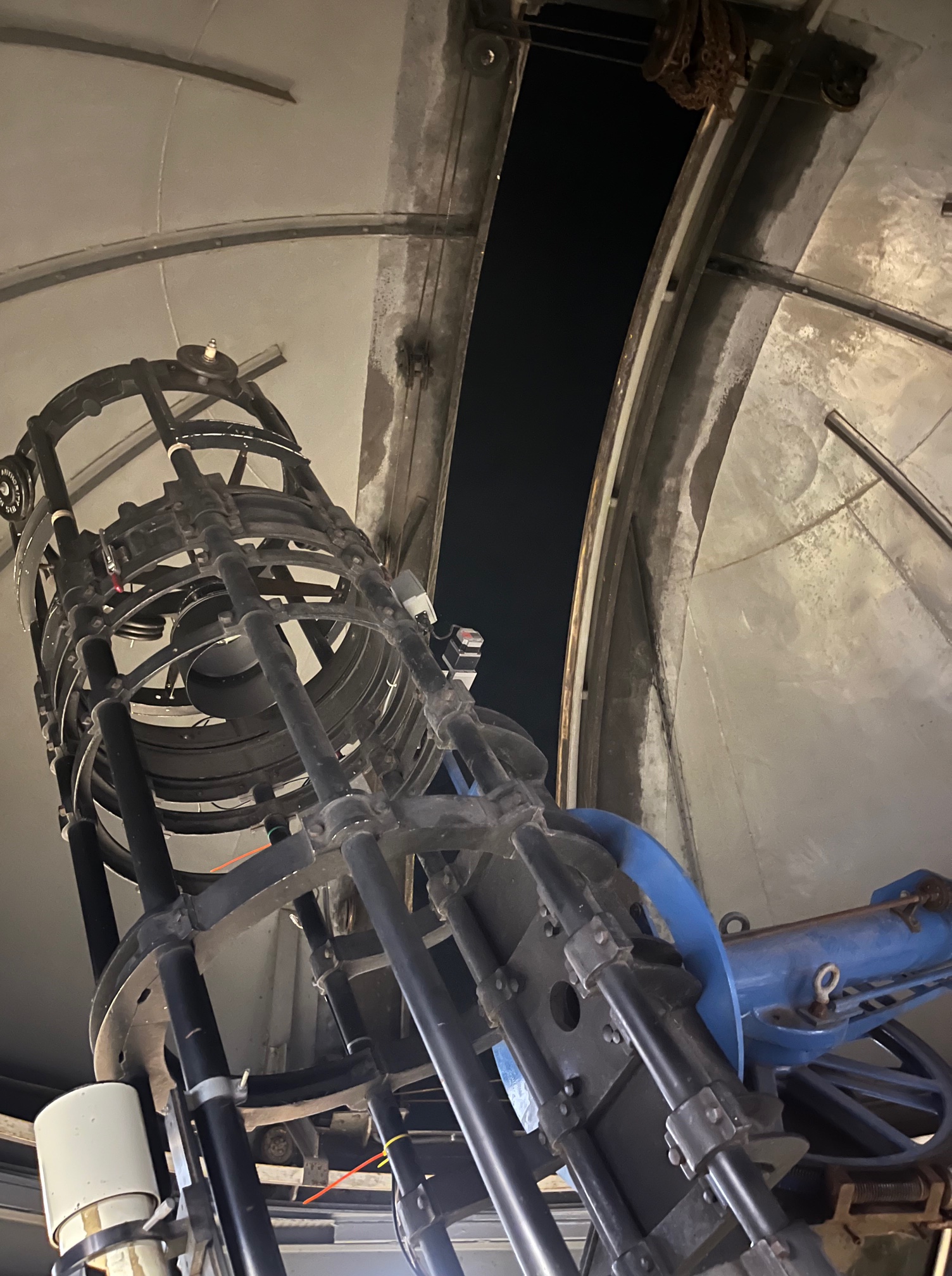
IU keeps the optical equipment, like the 24-inch mirror that is crucial to the telescope. So now they need a mirror.
Someone has a contact who can get them a big piece of glass from Germany. And these guys then spend the next two years slowly grinding, polishing and testing this into a 26-inch round mirror. The tube needs a bit of adapting but can handle the extra two inches.
At the same time, Princeton University is upgrading its observatory. These guys get its hand-me-down dome, 19 feet across. It’s slowly and carefully trucked to the area. An extra wide load.
And where is everything going? To a corner of this state park, leased for $1 a year starting in 1965, thanks to another contact.
The men have to refurbish the mount for the scope, which it seems they take on themselves. They get the building built. There’s lots of fundraising going on.
The viewing observatory is dedicated in October 1970 and named after Buzz Aldrin Jr., the second guy to step on the moon and a New Jersey native. (He’s busy escorting cosmonauts, so his dad attends in his place.) The telescope is operational in 1976.
And it’s still run by a bunch of amateur astronomers who will happily show you around and, if the skies are clear, point out the stars. It’s so dark there that on a clear night with low humidity (let’s think fall), they say you can see the Milky Way with the naked eye.
And if it’s not clear, ask them nicely and they might still open up the dome. Worked for me!
In addition to the big scope, they have smaller one that they take out on the back lawn. There are sun-safe screens in use for the Sunday afternoon viewings of the sun so you can see sun flares.
The grinder, by the way, is there too, tucked away in a corner.


Thanks for the great writeup!
LikeLike